Frank Werner Maiwald
Senior technical group supervisor at NASA's Jet Propulsion Laboratory who died suddenly on July 4, 2024, at age 61. No cause of death was disclosed. No press release from JPL. No memorial from NASA. No acknowledgment from Caltech. No news coverage. His obituary is the only public record of his death. He managed dual-use remote sensing instruments — civilian climate monitoring and defense ISR capabilities — including the SBG-VSWIR spectrometer and AMR-C advanced microwave radiometer. His death, identified by The Sentinel Network, extends the 2024-2026 scientist cluster timeline backward by nearly a year.
| Field | Details |
|---|---|
| Full Name | Frank Werner Maiwald |
| Born | June 24, 1964, Ratingen, Germany |
| Died | July 4, 2024 |
| Age at Death | 61 (ten days after 60th birthday) |
| Location of Death | Los Angeles, California |
| Cause of Death | Not disclosed |
| Official Ruling | None publicly available |
| Category | Scientist / Engineer |
Assessment: SUSPICIOUS
A senior JPL technical group supervisor managing cutting-edge dual-use remote sensing instruments died suddenly at 61 with no cause of death disclosed. No institutional acknowledgment exists from JPL, NASA, or Caltech. The same silence that met the deaths and disappearances of Monica Reza, Carl Grillmair, and the Wright-Patterson personnel met Maiwald nearly a year earlier. According to The Sentinel Network, colleague entries in the public memorial guest book make clear the death was sudden — the language of shock, not a long illness. JPL is where Monica Reza was working when she vanished eleven months later. And one year before Maiwald's death, JPL research scientist Michael David Hicks — also a longtime colleague — died at 59 with no cause of death disclosed and no autopsy record found, making Maiwald the second JPL scientist lost in two years.
Circumstances of Death
Frank Werner Maiwald died on July 4, 2024, in Los Angeles. His obituary contains no cause of death. No illness is mentioned. No decline is described. According to The Sentinel Network's analysis of his public memorial guest book, colleagues noted he had been actively engaged in ongoing projects and making plans for the future. The shock documented by his peers is described as "not the language of a long illness."
No entry has been located in the Los Angeles County Medical Examiner public database. No local news coverage from the LA Times, Pasadena Star-News, or any regional outlet has been identified.
Background
Maiwald earned his Ph.D. in Applied Physics from the University of Cologne, Germany, and joined JPL as a Post-Doctoral Fellow in April 1999. Over 25 years, he rose to Technical Group Supervisor in the Instrument Division, building a career spanning radiometry, terahertz spectroscopy, and orbital remote sensing. His early work included developing a 2.7-THz solid-state frequency-tripler source and leading a team that built a space-qualified multiplier chain in the 1.25-THz range — foundational technology for space-based spectroscopy. According to his publication trail on the NASA Technical Reports Server (NTRS), he managed the development of multiple major instruments:
- SBG-VSWIR — A visible shortwave infrared spectrometer designed for the Surface Biology and Geology mission (his final project, planned launch ~2028)
- AMR-C — Advanced Microwave Radiometer for Climate, which he had successfully delivered (two instruments for the Sentinel-6 mission)
- Juno MWR — He served as receiver lead for the microwave radiometer currently orbiting Jupiter
- Contributed to AMR/SWOT, COWVR, AMR/Jason 3, and HIFI (Herschel Space Observatory) programs
As The Sentinel Network noted, these are not obscure academic instruments. Visible shortwave infrared spectroscopy detects anomalous surface emissions and identifies materials from orbit. Advanced microwave radiometry enables all-weather target tracking and maritime domain awareness. The civilian applications are climate monitoring and oceanography. The defense applications are intelligence, surveillance, and reconnaissance. The technology is inherently dual-use, and Maiwald managed programs on both sides of that line.
He is survived by his wife of 25 years, YeonJae Maiwald, his father, and his siblings.
Why This Death Possibly Raises Questions
- No cause of death disclosed: The obituary mentions no illness, no decline, no circumstances. Colleagues' memorial entries suggest it was sudden and unexpected.
- Complete institutional silence: No press release from JPL. No memorial statement from NASA. No acknowledgment from Caltech. For a senior technical group supervisor managing major national programs, this absence is unusual.
- No media coverage: No local or national news outlet covered his death.
- Dual-use technology: His instruments had direct defense ISR applications alongside their civilian missions.
- JPL/Caltech corridor: JPL is where Monica Reza was working when she vanished eleven months later. Caltech/IPAC, where Carl Grillmair ran quality assurance on NEOWISE, is the same institutional family. According to The Sentinel Network: "Three people from the Southern California aerospace corridor. Reza invented the alloy. Grillmair validated the sensor pipeline. Maiwald managed the instruments. All three are gone."
- Timeline: If the 2024-2026 scientist cluster has a beginning, The Sentinel Network suggests it may be here: Independence Day, 2024.
The Fireball Blind Spot and 3I/ATLAS Context
The Sentinel Network's March 25, 2026 article "The Blind Spot: Rocks Are Falling Through Our Roofs" placed Maiwald's death in the context of a documented March 2026 spike in bright fireballs causing real-world damage — meteorites through roofs in Houston, sonic booms in Ohio, multiple events across Germany, California, and Michigan. The article argued that the scientist cluster represents the systematic removal of the talent pipeline that could detect, characterize, or publicly explain either incoming NEO threats or anomalous interstellar activity centered on 3I/ATLAS (the third confirmed interstellar object, discovered 2025). Maiwald's orbital surveillance instruments — which watch payloads and launches from orbit — are positioned by The Sentinel Network as part of the detection infrastructure being blinded. His SBG-VSWIR spectrometer detects anomalous surface emissions and identifies materials from orbit; his advanced microwave radiometry enables all-weather target tracking. The civilian applications are climate monitoring; the defense applications are the ability to independently verify what is entering Earth's atmosphere and from where.
The Counterargument
- Maiwald was 61. While sudden death at 61 warrants questions, it is not outside the range of natural causes — heart attack, stroke, aneurysm.
- The absence of institutional acknowledgment, while unusual, could reflect family wishes for privacy.
- No reporting has established any connection between Maiwald and UAP programs or exotic technology.
- His work, while dual-use, falls within conventional remote sensing — not exotic propulsion or UAP-adjacent physics.
- The connection to Reza and Grillmair is institutional proximity (JPL/Caltech corridor), not demonstrated professional collaboration.
- The Sentinel Network acknowledges: "We are not asserting a connection. We are documenting that the person best positioned to identify the blind spots in the detection infrastructure is on this list."
Key Quotes
"Three people from the Southern California aerospace corridor. Reza invented the alloy. Grillmair validated the sensor pipeline. Maiwald managed the instruments. All three are gone." — The Sentinel Network, March 2026
"If this pattern has a beginning, it may be here: Independence Day, 2024." — The Sentinel Network, March 2026
See Also
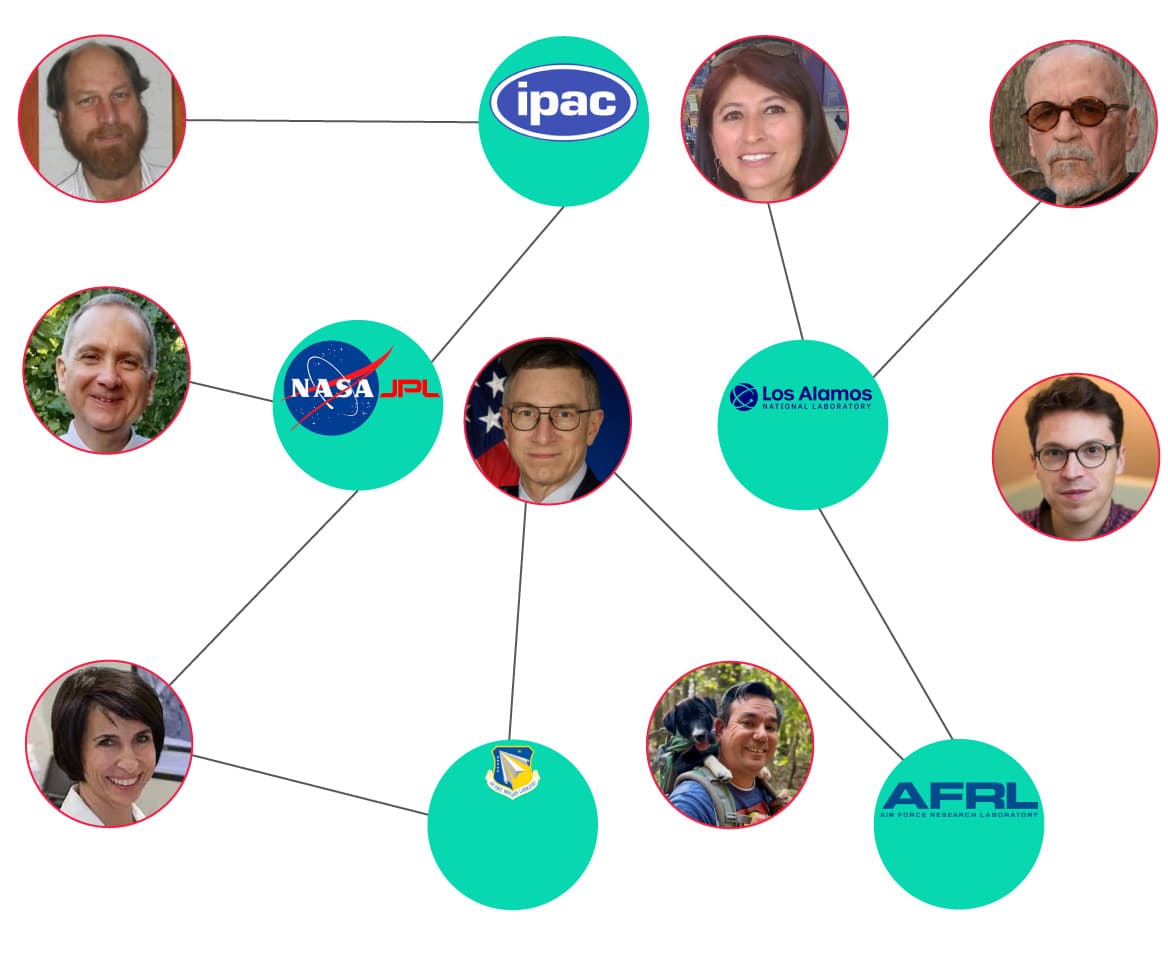
- JPL / LANL / AFRL Scientist Cluster 2023–2026 — Full overview of the nine scientists and defense insiders who died or vanished
- NASA JPL — Organization overview: four JPL-corridor scientists gone in three years
- Michael David Hicks — JPL research scientist (1998-2022), DART Project, died July 2023 — no cause disclosed; precedes Maiwald's death by one year from the same corridor
- Monica Jacinto Reza — JPL contractor, Mondaloy inventor, vanished June 2025
- Carl Grillmair — Caltech/IPAC astrophysicist, NEOWISE pipeline QA, shot February 2026
- Maj. Gen. William Neil McCasland — Former AFRL commander, vanished February 2026
- Anthony Chavez — Former LANL employee, vanished May 2025
- Melissa Casias — DOE advisory board member connected to LANL, vanished June 2025
- Nuno Loureiro — MIT plasma physicist, shot December 2025
Other Shocking Stories
- Karl Wolfe — Disclosure Project witness killed by truck while cycling, 2018
- Dorothy Kilgallen — Journalist found dead; notes and files on JFK/UFOs disappeared
- Arie DeGeus — Zero-point energy inventor found dead in car en route to secure funding
- Felix Moncla — F-89 pilot merged with unidentified radar target over Lake Superior; never found
Sources
- The Blind Spot — The Sentinel Network (March 2026)
- Frank Werner Maiwald Obituary — Legacy.com (July 2024)
- NASA Technical Reports Server — NTRS (Maiwald publication trail)
- THE BLIND SPOT: Rocks Are Falling Through Our Roofs — The Sentinel Network (March 25, 2026)
- Six Defense Scientists Dead Or Missing In Under A Year — IBTimes UK
Sentinel Network Cluster (March 2026 compiled list)
Maiwald's case is included in an 11-person cluster compiled by @thesentinelnet on X (March 25, 2026) spanning July 2024–February 2026 across CA, NM, MA, OH/Wright-Patterson, connecting JPL, Caltech/IPAC, LANL, AFRL, and MIT. Shared signatures across cases include factory-reset phones, items left behind, negative scent/cadaver-dog searches, and institutional silence. The cluster emphasizes overlaps with orbital surveillance, NEO/fireball detection, rocket propulsion/alloys, plasma/fusion, and UAP-adjacent research.
Specific to Maiwald: JPL senior technical manager who died July 4, 2024 in Los Angeles at age 61. Oversaw next-generation orbital surveillance instruments including the SBG-VSWIR spectrometer, AMR-C, and SWOT-related radiometry/terahertz technology — dual-use for ISR/surveillance. No cause of death, no press release, and no memorial from JPL/NASA/Caltech; only an obituary confirms his death.
See also: JPL/LANL/AFRL Scientist Cluster
This information was built by Grok and Claude AI research.
Status: Deceased (2024)
Additional context from the UAP Physics Murders investigation
NASA Jet Propulsion Laboratory senior engineer and technical group supervisor who managed development of advanced space instruments across a 25-year career. Died in Los Angeles on July 4, 2024, at age 61. Cause of death was never made public. No autopsy was performed.
| Field | Details |
|---|---|
| Full Name | Frank Werner Maiwald |
| Born | June 24, 1964, Ratingen, Germany |
| Died | July 4, 2024, Los Angeles, California (age 61) |
| Role | Senior Radio Frequency Engineer / Technical Group Supervisor |
| Platform | NASA JPL, scientific publications, instrumentation programs |
| Notable Works | SBG-VSWIR instrument, COWVR radiometer (DoD), AMR-C for Sentinel-6, HIFI for Herschel Space Observatory, biosignature detection research; 76 publications, 3,243+ citations |
Biography
Frank Werner Maiwald was born on June 24, 1964, in Ratingen, Germany. He earned his PhD in Applied Physics from the I. Physikalisches Institut at the University of Cologne (Universität zu Köln), where his doctoral work focused on terahertz frequency multiplier technology.
In April 1999, Maiwald joined NASA's Jet Propulsion Laboratory as a Post-Doctoral Fellow. Over the next 25 years, he rose to the rank of Technical Group Supervisor and Senior Radio Frequency Engineer, managing increasingly complex and strategically important instrumentation programs. He was married to YeonJae Maiwald for 25 years and is survived by his father Bernhard Maiwald (with wife Marianne), siblings Ralph, Berndt, and Anja Maiwald, and sisters-in-law Soohee and Yunsu Chang.
Career at NASA JPL (1999–2024)
Early Career — Terahertz Instrumentation
Maiwald's early work at JPL focused on terahertz and submillimeter-wave technology:
- Developed a 2.7-THz solid-state frequency-tripler source for the Herschel Space Observatory's HIFI instrument (Heterodyne Instrument for Far Infrared)
- Led development of a space-qualified multiplier chain in the 1.25-THz range for HIFI
- Co-authored papers on THz frequency multiplier chains based on planar Schottky diodes
- Contributed to development of 200-GHz to 2.7-THz multiplier chains for submillimeter-wave heterodyne receivers
- The HIFI instrument launched aboard ESA's Herschel Space Observatory in May 2009
Mid-Career — Microwave Radiometry
Maiwald managed development of critical Earth-observation and defense instruments:
- COWVR (Compact Ocean Wind Vector Radiometer) — a low-cost, fully-polarimetric imaging radiometer operating at 18.7, 23.8, and 33.9 GHz, developed as a proof-of-concept for the Air Force/Department of Defense. Now installed on the International Space Station as part of STP-H8
- AMR/Jason 3 — Advanced Microwave Radiometer for the Jason-3 ocean altimetry mission
- AMR-C for Sentinel-6 — Oversaw successful delivery of two instruments for the AMR-C program (ESA/NASA collaboration)
- AMR/SWOT — Microwave radiometer for the Surface Water and Ocean Topography mission
- Juno — Contributed to instruments for the Jupiter orbiter
Late Career — Spectroscopy and Life Detection
In his final years at JPL, Maiwald's work expanded into areas directly relevant to the search for extraterrestrial life:
- SBG-VSWIR — Managed development of the Surface Biology and Geology Visible to Short-Wave Infrared instrument, a wide-swath imaging spectrometer
- Biosignature Detection Research — Collaborated on research using cryogenic ion vibrational spectroscopy to unambiguously detect molecular biosignatures (amino acids, fatty acids, nucleobases, sugars) on ocean worlds like Europa, Enceladus, and Titan. This technique addresses a critical limitation of mass spectrometry: the inability to distinguish biological markers from non-biogenic isomers with identical atomic compositions. The action spectroscopy approach adds infrared structural identification to mass identification, enabling unambiguous biosignature detection for future missions.
This research was conducted in collaboration with JILA (University of Colorado Boulder/NIST). A related paper on cryogenic ion vibrational spectroscopy of protonated amino acids (specifically valine) was published in the Journal of Physical Chemistry A in 2024.
Their Claims
Maiwald was not a public figure in UAP discourse. His significance lies in his work at the intersection of advanced instrumentation, defense applications, and life-detection technology:
- His instruments had documented dual-use applications spanning climate monitoring and intelligence, surveillance, and reconnaissance (ISR)
- The COWVR radiometer was specifically developed for the Air Force/Department of Defense
- His SBG-VSWIR imaging spectrometer uses visible-shortwave-infrared spectrometry applicable to both Earth science and defense
- His late-career pivot to biosignature detection put him at the forefront of research that could confirm extraterrestrial life on ocean worlds within our solar system
Death Circumstances
Frank Maiwald died on July 4, 2024, in Los Angeles, California, at age 61.
What is known:
- The cause of death was never made public
- Authorities confirmed that no autopsy was performed
- NASA and JPL issued no press release, no official statement, and no institutional acknowledgment
- Caltech (which manages JPL) issued no acknowledgment
- No local news coverage documented the death at the time
What colleagues said: Memorial comments from JPL colleagues on Legacy.com suggest the death was unexpected. None of the memorial messages mention illness, prior health decline, or circumstances of death — they focus on celebrating his character and contributions. Colleague Alan Mazer praised his work on MWR and other instruments; colleague Bill Hatch referenced his contributions to the Juno mission.
What is suspicious:
- A 61-year-old scientist at America's premier space research laboratory dies and no cause of death is released
- No autopsy was performed despite the unexplained death
- JPL, NASA, and Caltech — institutions that typically honor their researchers — issued no statements
- The death occurred just 13 months after he led breakthrough biosignature detection research
- His instruments had dual-use defense and intelligence applications
Key Quotes
"He was always available and always willing to provide help and guidance." — Alan Mazer, JPL colleague, Legacy.com memorial, 2024
Key Arguments & Evidence They Cite
- Maiwald's 25-year career at JPL involved increasingly sensitive instrumentation with dual-use civilian and military applications
- The COWVR radiometer was a DoD program, not purely scientific
- His biosignature detection research could fundamentally alter the search for extraterrestrial life
- His death fits the pattern of unexplained deaths among scientists connected to defense and space research programs (2024-2026)
- The absence of an autopsy and the silence from JPL/NASA/Caltech is anomalous for a senior researcher
Connection to the 2024-2026 Scientist Death Pattern
Maiwald is the first chronological case in a pattern of eight or more deaths and disappearances involving scientists connected to sensitive U.S. government research between July 2024 and early 2026:
- Frank Maiwald (JPL) — died July 4, 2024, cause undisclosed, no autopsy
- Anthony Chavez (Los Alamos) — vanished May 4, 2025, never found
- Monica Jacinto Reza (JPL) — vanished June 22, 2025, never found
- Melissa Casias (Los Alamos) — vanished June 26, 2025, phones wiped, never found
- Nuno Loureiro (MIT) — shot December 2025
- Jason Thomas (Novartis/DoD) — vanished December 2025, body found March 2026
- Carl Grillmair (Caltech/IPAC) — shot February 2026
- William McCasland (AFRL) — vanished February 2026, never found
Maiwald and Monica Jacinto Reza form a JPL cluster — both worked at the same laboratory and both died or disappeared within 12 months of each other. Maiwald also worked on instruments that could advance the very biosignature detection capabilities that might eventually confirm extraterrestrial origins of recovered UAP materials.
Rep. Tim Burchett (R-TN) stated regarding the broader pattern: "Something dark is going on. I know these scientists and researchers. They have testified. We've got to get to the bottom of it."
The Counterargument
- Maiwald was 61 years old; sudden death from natural causes (heart attack, stroke, aneurysm) occurs at this age
- The absence of an autopsy could reflect family wishes rather than a cover-up
- JPL's silence could reflect family privacy requests rather than institutional suppression
- There is no documented direct connection between Maiwald and UAP research or classified programs beyond the dual-use nature of his instruments
- The biosignature detection research was publicly published, not classified — suggesting it was not being suppressed
- Correlation with other scientist deaths does not prove causation; law enforcement has not linked these cases
Related Perspectives
- Monica Jacinto Reza — Fellow JPL researcher who vanished 12 months after Maiwald's death; both worked at the same laboratory
- William McCasland — Retired AFRL commander who disappeared February 2026; part of the same pattern of scientist deaths/disappearances
- Nuno Loureiro — MIT plasma physicist shot December 2025; part of the same pattern
- Jason Thomas — Novartis chemical biologist who vanished December 2025; part of the same pattern
See Also
- Exotic_Metamaterials — Maiwald's biosignature detection techniques could theoretically be applied to analysis of recovered exotic materials
- Zero_Point_Energy — Advanced energy research overlaps with JPL's dual-use instrumentation portfolio
Sources
- Frank Maiwald Obituary — Legacy.com
- Frank Maiwald Memorial — Legacy.com
- Frank Maiwald — ResearchGate Profile
- Frank Maiwald — Google Scholar
- JPL Technical Reports — Frank Maiwald
- JILA — Unambiguous Detection of Biosignatures by Action Spectroscopy
- The Sentinel Network — "The Blind Spot"
- CLG News — Mystery of Scientists Dead or Missing Rises to 8
- ZeroHedge — Nine Top-Level Scientists Die or Go Missing in Past Year
- BroBible — Scientists Involved in Secret Research Dead or Missing
- American Greatness — Nine Scientists
- @TruthXVector — US Scientist Cluster & BROWN-CAHILL METHOD Diagram — X — Documents the pattern of 8 dead/missing US scientists; Maiwald's JPL advanced sensors/microwave systems expertise maps onto the dual-use aerospace sensors subsystem of the alleged classified antigravity propulsion diagram
This information was compiled by Claude AI research.
Investigations: UAPs Murders (General), UAP Physics Murders