Dorothy Kilgallen
Journalist who broke the British military UFO investigation story and was investigating the JFK assassination, found dead under circumstances the medical examiner called "undetermined."
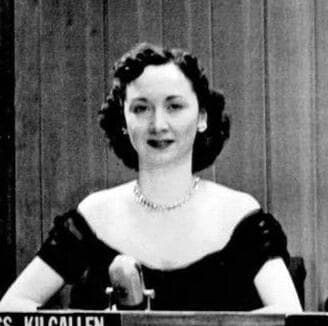
| Field | Details |
|---|---|
| Full Name | Dorothy Mae Kilgallen |
| Born | July 3, 1913 |
| Died | November 8, 1965 |
| Age at Death | 52 |
| Location of Death | Manhattan townhouse, 45 East 68th Street, New York City |
| Cause of Death | Combination of alcohol and barbiturates |
| Official Ruling | Circumstances undetermined (medical examiner emphasized "the overdose could well have been accidental") |
| Category | Journalist / Investigator |
Assessment: HIGHLY SUSPICIOUS
Kilgallen's death intersects two of the most significant cover-up narratives of the 20th century: the JFK assassination and the UFO phenomenon. She was one of the first mainstream journalists to break the story that British military intelligence was seriously investigating UFOs (1954). She was also the only journalist to secure a private interview with Jack Ruby and had published his sealed Warren Commission testimony. She was found dead in the wrong room of her home, fully dressed and made up, in a bed she never used. Her investigative notes and file on the JFK assassination disappeared and have never been found.
Circumstances of Death
On November 8, 1965, Kilgallen was found dead in her Manhattan townhouse. She was found in a third-floor bedroom that she reportedly never used, sitting upright in bed, fully clothed and made up — unusual for someone who had allegedly died in her sleep. A book was open beside her.
New York City medical examiner James Luke determined the cause of death was a combination of alcohol and barbiturates but stated the circumstances were "undetermined," emphasizing that "the overdose could well have been accidental."
Background
Dorothy Kilgallen was one of America's most prominent journalists, writing the "Voice of Broadway" column for the New York Journal-American and appearing as a regular panelist on the CBS television program What's My Line? She was a formidable investigative journalist who ventured beyond gossip into politics, organized crime, and government secrecy.
UFO Investigation
In 1954, Kilgallen published a major story claiming that the British military was conducting serious investigations into UFOs. According to some accounts, she had obtained information suggesting that government officials had recovered wreckage from a crashed craft. Her May 23, 1955 column reportedly stated: "Flying saucers are regarded as of such vital importance that they will be the subject of a special hush-hush meeting of the world military heads next summer." This was one of the earliest mainstream media reports treating military UFO investigation as a real and significant story.
JFK Assassination Investigation
In 1964, Kilgallen became the only journalist to secure a private interview with Jack Ruby, the man who killed Lee Harvey Oswald. She also obtained and published Ruby's closed-door testimony to the Warren Commission, refusing to reveal her source. She reportedly told friends she was going to "break the real story" behind the Kennedy assassination and "bring the house down."
Why This Death Possibly Raises Questions
- Found in a room she never used, fully dressed and made up — inconsistent with accidental overdose during sleep
- Her JFK investigation file and notes disappeared after her death and have never been recovered
- She was one of the very few journalists pursuing both the UFO and JFK assassination stories simultaneously
- The medical examiner ruled the circumstances "undetermined" — not suicide, not accident, not homicide
- She had reportedly told friends she had information that would "break the case wide open"
- She was one of the first mainstream journalists to report on British military UFO investigations
- The Manhattan District Attorney's Office conducted an eight-month investigation in 2015 but "found no evidence" of murder — though the investigation occurred 50 years after the death
- Some researchers have connected her UFO reporting to a alleged CIA wiretap document mentioning Marilyn Monroe's intention to go public about UFOs — both women died under disputed circumstances
The Counterargument
- Kilgallen was known by colleagues and friends to regularly mix barbiturates and alcohol; her personal physician had explicitly warned her about the dangerous combination before her death
- The medical examiner found lethal levels of both substances and specifically stated that "the overdose could well have been accidental" — reflecting a realistic assessment, not an evasion
- She had been drinking the evening before her death; disorientation from alcohol and barbiturate effects could account for her being found in an unfamiliar bedroom, without requiring a staging theory
- Multiple friends and colleagues have stated that Kilgallen sometimes exaggerated the significance of her JFK findings and that her private interviews and materials may not have contained the decisive breakthrough information she implied; the missing notes, while notable, may not have contained what her admirers assumed
- The Manhattan District Attorney's 2015 investigation — conducted eight months and involving a formal review of evidence — found no basis to conclude murder; while this occurred 50 years later, it represents the most recent prosecutorial assessment
- The combination of barbiturates and alcohol causing accidental death was not unusual for the era; similar deaths occurred among other public figures of the same period without generating the same degree of suspicion
- Her being found "fully dressed and made up" could indicate she had been awake late — as was her habit — and simply fell asleep or lost consciousness in a guest room after taking medication
Key Quotes from Media Coverage
"I'm going to break the real story and have the biggest scoop of the century." — Dorothy Kilgallen, reportedly to friends, regarding her JFK assassination investigation
"The circumstances of her death were undetermined." — Medical Examiner James Luke
See Also
- [Dorothy Kilgallen (Intel Murders)]# — This case also appears in the Intelligence Service Murders project
- James Forrestal — Government insider who allegedly knew about recovered craft, died under suspicious circumstances (1949)
- Frank Edwards — UFO journalist who died under suspicious circumstances (1967)
- John Murphy — Radio journalist killed in a hit-and-run after Men in Black warned him to stop investigating the Kecksburg UFO crash
- Peter Jennings — ABC News anchor who died of fast-acting cancer months after airing a major primetime UFO special
Other Shocking Stories
- Wilbert B. Smith: Canadian government engineer who ran Project Magnet, Canada's official UFO study, and concluded UFOs were extraterrestrial in origin
- Frederick Valentich: Australian pilot who disappeared over Bass Strait in 1978 after radioing Melbourne air traffic control to report an...
- Richard Pugh: MOD computer consultant found dead with a plastic bag over his head and rope coiled four times around...
- Tony Dodd: British police sergeant turned full-time UFO investigator who died of an inoperable brain tumor in 2009, after 21...
Sources
- Dorothy Kilgallen — Wikipedia
- Dorothy Kilgallen — Britannica
- Dorothy Kilgallen — Spartacus Educational
- San Diegans Probe 1965 Dorothy Kilgallen 'Murder Mystery' — Times of San Diego
- Reporter's Mysterious Death / Nightmare UFO Encounter — Coast to Coast AM
This information was built by Grok and Claude AI research.
Status: Deceased (1965)
Additional context from the UAP Physics Murders investigation
Pioneering American journalist, syndicated columnist, and television personality on CBS's What's My Line?, who investigated both the JFK assassination and UFO phenomena, and whose death at age 52 from a combination of barbiturates and alcohol was ruled "circumstances undetermined" by the New York City medical examiner.
| Field | Details |
|---|---|
| Full Name | Dorothy Mae Kilgallen |
| Born | July 3, 1913, Chicago, Illinois |
| Died | November 8, 1965 (age 52), Manhattan, New York |
| Role | Journalist / Syndicated Columnist / Television Panelist / Author |
| Platform | New York Journal-American, International News Service (INS), CBS What's My Line?, WOR Radio |
| Notable Works | "Voice of Broadway" syndicated column, What's My Line? panelist (1950-1965), 1955 UFO report from London, JFK assassination investigation |
Biography
Dorothy Mae Kilgallen was born on July 3, 1913, in Chicago, Illinois, the eldest daughter of James Lawrence Kilgallen, a prominent journalist with the Hearst Corporation's International News Service, and Mae Ahern Kilgallen. She grew up in Chicago, Indianapolis, and Brooklyn, New York, following her father's career. She graduated from Erasmus Hall High School in Brooklyn in 1930 and briefly attended the College of New Rochelle before leaving to pursue journalism full-time.
Kilgallen began her career at the New York Evening Journal shortly before her 18th birthday. By age 20, she had earned substantial stature at the paper. In 1936, she won national acclaim for her "Girl Around the World" series, chronicling a competing round-the-world race by air that placed her among the most recognized reporters in America.
She married actor and producer Richard Kollmar on April 6, 1940. The couple had three children and hosted the popular radio program "Breakfast with Dorothy and Dick" on WOR from their Park Avenue apartment beginning in 1945.
Kilgallen became a panelist on CBS's What's My Line? beginning with its first broadcast on February 2, 1950, appearing nearly every Sunday evening for 15 years. Her syndicated column "Voice of Broadway" reached millions of readers daily through the Hearst newspaper chain and the King Features Syndicate. At the height of her career, she was among the most influential media figures in the United States, with a readership estimated at 20 million people.
UFO Investigation and Reporting
Kilgallen's connection to UAP-related topics is documented through her journalism and her access to high-ranking military and government officials.
On May 22, 1955, Kilgallen published a column from London, syndicated through the International News Service, that appeared on the front page of the New York Journal-American. In the column, she reported:
"British scientists and airmen, after examining the wreckage of one mysterious flying ship, are convinced these strange aerial objects are not optical illusions or Soviet inventions, but are flying saucers which originate on another planet."
Kilgallen attributed this information to "a British official of Cabinet rank who prefers to remain unidentified." The column further stated that the source claimed: "We believe, on the basis of our inquiry thus far, that the saucers were staffed by small men -- probably under four feet tall. It's frightening, but there is no denying the flying saucers come from another planet."
This report is significant for several reasons:
- Source credibility: Kilgallen identified her source as a Cabinet-rank British government official, placing the claim at the highest levels of government
- Physical evidence claim: The report referenced examination of actual wreckage, not merely sightings or radar contacts
- Mainstream platform: The column appeared on the front page of a major American newspaper, not in a fringe publication
- Access and contacts: Kilgallen's social circles included aristocracy, royalty, and military leadership, giving her access to information unavailable to most reporters
The 1955 column represents one of the earliest instances of a mainstream American journalist reporting, on the record, that a senior government official had confirmed the extraterrestrial origin of UFOs based on physical evidence examination.
JFK Assassination Investigation
Beginning in 1963, Kilgallen devoted significant investigative effort to the assassination of President John F. Kennedy. She found the official conclusion that Lee Harvey Oswald acted alone "laughable" and spent 18 months cultivating sources and gathering evidence.
In 1964, Kilgallen secured a private interview with Jack Ruby, the Dallas nightclub owner who shot Oswald on live television two days after the assassination. She was reportedly the only journalist granted such access. During this period, Kilgallen told associates, including her lawyer, "I'm going to break the real story and have the biggest scoop of the century."
At the time of her death, Kilgallen was reportedly working on a book about the Kennedy assassination. The intersection of her JFK investigation and her earlier UFO reporting has led some researchers to speculate that her access to classified information extended across multiple sensitive topics.
Death Circumstances
On the morning of November 8, 1965, Dorothy Kilgallen was found dead in her Manhattan townhouse. The circumstances surrounding her death contained multiple anomalies that have never been satisfactorily explained:
Wrong room: Kilgallen was found in a third-floor bedroom that she reportedly never used for sleeping. She customarily slept on the fifth floor of the townhouse, while her husband slept on the fourth floor.
Wrong attire: She was found wearing full makeup, false eyelashes, and a hairpiece -- not the pajamas she normally wore to bed. This has been cited as inconsistent with someone who had voluntarily gone to sleep.
The book: She was positioned as though she had fallen asleep reading a novel by Robert Ruark, but she had written in her own column months earlier that she had already finished the book, even revealing that the protagonist dies at the end.
Toxicology: Dr. James Luke, the New York City medical examiner, determined the cause of death was "acute ethanol and barbiturate intoxication." Neither the alcohol nor the barbiturate levels alone were sufficient to cause death, but their combination proved fatal. The amount of secobarbital sodium found in her bloodstream would have required ingestion of 15 to 20 Seconal capsules, far exceeding her normal prescription dose of two capsules nightly.
1968 retesting: Three years after her death, retesting of preserved tissue samples using a newer analytical process revealed that Kilgallen had died from a combination of three barbiturates: secobarbital, amobarbital, and pentobarbital. This was significant because Kilgallen had a prescription only for Seconal (secobarbital); the presence of two additional barbiturates was never explained.
Official ruling: Dr. Luke classified the manner of death as "circumstances undetermined," stating there was no way of determining whether the death was suicide, accident, or homicide.
Disappearance of Research Files
Following Kilgallen's death, her extensive JFK assassination research files -- including notes from her private interview with Jack Ruby and materials she had gathered over 18 months of investigation -- disappeared. No comprehensive inventory of her papers was made public. The files were never logged, catalogued, or recovered. Family members and colleagues stated they never received the notes, and no archive or institution has acknowledged holding them.
The New York Public Library holds the Dorothy Kilgallen papers and scrapbooks, but these do not contain the JFK investigation materials.
Legacy
Dorothy Kilgallen remains one of the most prominent American journalists whose death has been classified as undetermined. The combination of her UFO reporting, her JFK assassination investigation, her access to high-level government and military sources, and the anomalous circumstances of her death have made her case a focal point for researchers examining the suppression of investigative journalism on sensitive national security topics.
Author Mark Shaw documented the case in his 2016 book The Reporter Who Knew Too Much and its 2019 follow-up Denial of Justice, arguing that the evidence supports the conclusion that Kilgallen was murdered to prevent publication of her findings. In 2020, Shaw formally requested that the NYPD reopen the investigation into her death.
Related Perspectives
- Exotic Metamaterials -- Kilgallen's 1955 report referenced examination of physical wreckage, connecting to the broader study of recovered UAP materials
- Hal Puthoff -- Physicist who has investigated exotic physics through government-connected programs, part of the broader pattern of classified UAP research
- Eugene Mallove -- Another researcher investigating unconventional physics who was killed under suspicious circumstances
- Amy Eskridge -- Scientist whose death was alleged to be connected to her antigravity research; represents the pattern of suppressed researchers
- John Murphy -- Radio journalist who documented the 1965 Kecksburg UFO crash, had his documentary censored by government officials, and was killed in an unsolved hit-and-run; another journalist who died after investigating sensitive topics
Sources
- Dorothy Kilgallen - Britannica
- Dorothy Kilgallen - Wikipedia
- Dorothy Kilgallen, The Journalist Who Died Probing The JFK Assassination - All That's Interesting
- Did Journalist Dorothy Kilgallen's Probe of JFK's Assassination Lead to Her Death? - HowStuffWorks
- Dorothy Kilgallen - Spartacus Educational
- Dorothy Kilgallen: British Official Says Objects Originate From Some Other Planet - The UFO Chronicles
- Kilgallen, Dorothy (1913-1965) - Encyclopedia.com
- Circumstances Undetermined: Dorothy Kilgallen and JFK's Murder - Donald E. Wilkes Jr., University of Georgia
- Dorothy Kilgallen papers and scrapbooks - New York Public Library Archives
- The Reporter Who Knew Too Much - Mark Shaw (2016)
This information was compiled by Claude AI research.
Status: Deceased (1965)
Investigations: UAPs Murders (General), UAP Physics Murders