Michael David Hicks
NASA JPL research scientist and asteroid/comet specialist who died on July 30, 2023, at age 59. No cause of death was ever made public. No record of an autopsy being performed could be found. He worked at JPL from 1998 to 2022 and was personally involved with the DART Project — NASA's test to determine whether humans could deflect a dangerous asteroid away from Earth. The Daily Mail identified him on April 7, 2026, as the ninth person with ties to America's space or nuclear secrets to have died or mysteriously vanished in recent years, noting that three of his closest colleagues — Frank Maiwald, Monica Reza, and Carl Grillmair — also died or disappeared in the years immediately following his death.
| Field | Details |
|---|---|
| Full Name | Michael David Hicks |
| Born | February 7, 1964, Dayton, Ohio |
| Died | July 30, 2023 |
| Age at Death | 59 |
| Location of Death | Sunland, California (Los Angeles area) |
| Cause of Death | Not disclosed |
| Official Ruling | None publicly available; no autopsy record found |
| Employer | NASA Jet Propulsion Laboratory (JPL), 1998–2022 |
| Category | Scientist / Astronomer / Planetary Defense |
Assessment: MODERATE SUSPICION
A NASA JPL research scientist with over 80 peer-reviewed papers — including direct work on asteroid deflection and near-Earth object characterization — died at 59 with no cause of death ever publicly disclosed. No autopsy record has been located. He was personally involved with the DART Project, which tests the very technology that would determine whether humans can redirect a dangerous asteroid heading for Earth. Three colleagues from the same JPL/Caltech corridor died or vanished in the fourteen months that followed: Frank Maiwald (died July 2024), Monica Reza (vanished June 2025), and Carl Grillmair (shot February 2026). There are no public allegations of foul play specific to Hicks, and no known connection to classified UAP programs. The concern rests almost entirely on the institutional silence and the pattern of JPL/Caltech deaths that followed.
Circumstances of Death
Michael David Hicks died on July 30, 2023, in the Sunland area of Los Angeles — a community in the foothills north of the city, close to JPL in Pasadena. He was 59 years old. His obituary mentions no illness, no medical history, and no circumstances. The death appeared sudden.
No cause of death has been publicly released. According to the Daily Mail's April 7, 2026, investigation, no record of an autopsy being performed could be found. NASA, JPL, and the University of Arizona — his alma mater and his primary institutional affiliation — made no public statements about his passing. There was no JPL press release, no NASA memorial, and no Caltech acknowledgment.
The Daily Mail's coverage, which identified him as the "ninth person" in the pattern of space and nuclear secrets deaths, noted that all of this silence mirrored the institutional response to the deaths that followed: Frank Maiwald, his longtime JPL coworker, received the same treatment when he died in July 2024. No cause, no statement, no press release.
Background
Career at JPL
Hicks joined the Jet Propulsion Laboratory in 1998 as a postdoctoral research associate and remained there until 2022 — a tenure of 24 years. He held a Ph.D. in Lunar and Planetary Science from the University of Arizona's Lunar and Planetary Laboratory (1997), where he completed a dissertation titled "A Spectrophotometric Survey of Comets and Earth-Approaching Asteroids." He also held degrees from Boston University.
Over his career, Hicks published more than 80 peer-reviewed scientific papers. His specialty was the physical properties of comets and asteroids — particularly near-Earth objects (NEOs), the rocks that orbit close enough to Earth to pose a long-term impact threat.
Major Projects and Missions
- DART Project (Double Asteroid Redirection Test) — NASA's first planetary defense test, designed to determine whether a spacecraft impact could deflect a dangerous asteroid away from Earth. Hicks was a participating scientist on the DART science team.
- Deep Space 1 Mission — An early JPL mission that tested twelve experimental technologies in space, culminating in a flyby of Comet Borrelly in 2001. Hicks participated in the scientific analysis of the comet encounter.
- Near-Earth Asteroid Tracking (NEAT) Project — A JPL program specifically designed to survey and catalog near-Earth asteroids before they pose a threat. Hicks helped characterize the physical properties of objects detected by NEAT.
- Dawn Mission — NASA's mission to the asteroid belt, orbiting Vesta and Ceres. Hicks contributed to the scientific work on this mission.
- Asteroid Braille research — Participated in early characterization of asteroid Braille, one of the first close-approach NEO studies.
His research collaborators included Dr. Bonnie Buratti, a senior JPL researcher in planetary science.
Dual-Use Technology Context
The DART Project and NEAT are framed by the space community as planetary defense — protecting Earth from asteroid impacts. However, asteroid deflection technology has direct defense implications: the same propulsion and targeting expertise that redirects an asteroid can inform the design of kinetic interceptors for missile defense. The orbital mechanics of NEO characterization are closely related to the tracking of hypersonic and ballistic threats. Hicks's deep familiarity with the physical properties of fast-moving space objects — their albedo, composition, spin state, and trajectory — represents knowledge that sits at the intersection of planetary science and national security.
Personal Life
Beyond his scientific work, Hicks was described as an astronomer, artist, and father. He worked in multiple visual media: woodblock prints, oil painting, and metalwork. He played ukulele and regularly performed during observing sessions at Mount Palomar Observatory, bringing music to the long nights at the telescope. His obituary describes him as someone whose life extended in every direction beyond his career.
He left behind family and was mourned by colleagues at JPL and the University of Arizona's planetary science community.
The JPL Cluster: Four Scientists, Three Years
The Daily Mail's April 7, 2026, investigation explicitly noted that three of the scientists closely tied to Hicks also died or disappeared:
- Frank Maiwald — Hicks's longtime JPL coworker. Senior Technical Group Supervisor managing dual-use remote sensing instruments. Died July 4, 2024 — eleven months after Hicks. No cause of death disclosed. No autopsy. No institutional acknowledgment.
- Monica Reza — Director of JPL's Materials Processing Group at the time of her disappearance. Vanished June 22, 2025 while hiking in the Angeles National Forest. Was 30 feet behind her hiking companion when she disappeared without a trace.
- Carl Grillmair — Caltech/IPAC astrophysicist whose data pipeline ran through the same JPL campus. Shot and killed on the porch of his home in Llano, California, on February 16, 2026.
As The Sentinel Network noted: "Three people from the Southern California aerospace corridor. Reza invented the alloy. Grillmair validated the sensor pipeline. Maiwald managed the instruments. All three are gone." With Hicks's death in 2023 added to this group, the JPL/Caltech corridor has lost four scientists in three years — and the first of them died without any public explanation.
Why This Death Possibly Raises Questions
- No cause of death disclosed: The obituary contains no mention of illness, accident, or circumstances. Death appeared sudden at age 59.
- No autopsy record: The Daily Mail's investigation found no record of any autopsy being performed, which is unusual for an unexpected death at 59.
- Complete institutional silence: No press release from JPL. No memorial statement from NASA. No acknowledgment from Caltech. No coverage from local or national press. This mirrors the exact institutional silence surrounding Maiwald's death eleven months later.
- DART Project involvement: Hicks was a science team member on NASA's asteroid deflection mission — technology with direct dual-use national security implications.
- JPL corridor pattern: His three closest institutional colleagues — Maiwald, Reza, and Grillmair — all died or vanished within the three years after his death.
- The "ninth" identification: On April 7, 2026, the Daily Mail explicitly identified Hicks as the ninth person in the pattern of space and nuclear secrets deaths and disappearances, citing national security experts alarmed by the growing list.
The Counterargument
- Hicks was 59 at death, which while younger than average is not outside the range of natural causes — heart attack, stroke, or aneurysm can occur at that age without warning.
- His death in July 2023 predates the main 2024-2026 scientist cluster by over a year. The connection to Maiwald, Reza, and Grillmair may be institutional proximity rather than a causal link.
- No public allegations of foul play have been made by anyone who knew Hicks.
- His published work was in observational planetary science — not classified defense programs.
- Unlike some cluster members, no evidence has emerged that he held a security clearance or worked on classified projects.
- The Daily Mail's April 2026 framing as the "ninth person" may reflect pattern-matching rather than evidence of a connection.
The 2023-2026 JPL/Caltech Corridor
| Name | Institution | Date | Event |
|---|---|---|---|
| Michael David Hicks (this profile) | JPL (1998-2022) | July 30, 2023 | Died — no cause disclosed, no autopsy found |
| Frank Maiwald | JPL | July 4, 2024 | Died — no cause disclosed, no autopsy |
| Monica Reza | JPL | June 22, 2025 | Vanished hiking — no trace found |
| Carl Grillmair | Caltech/IPAC | Feb 16, 2026 | Shot and killed on his porch |
See Also
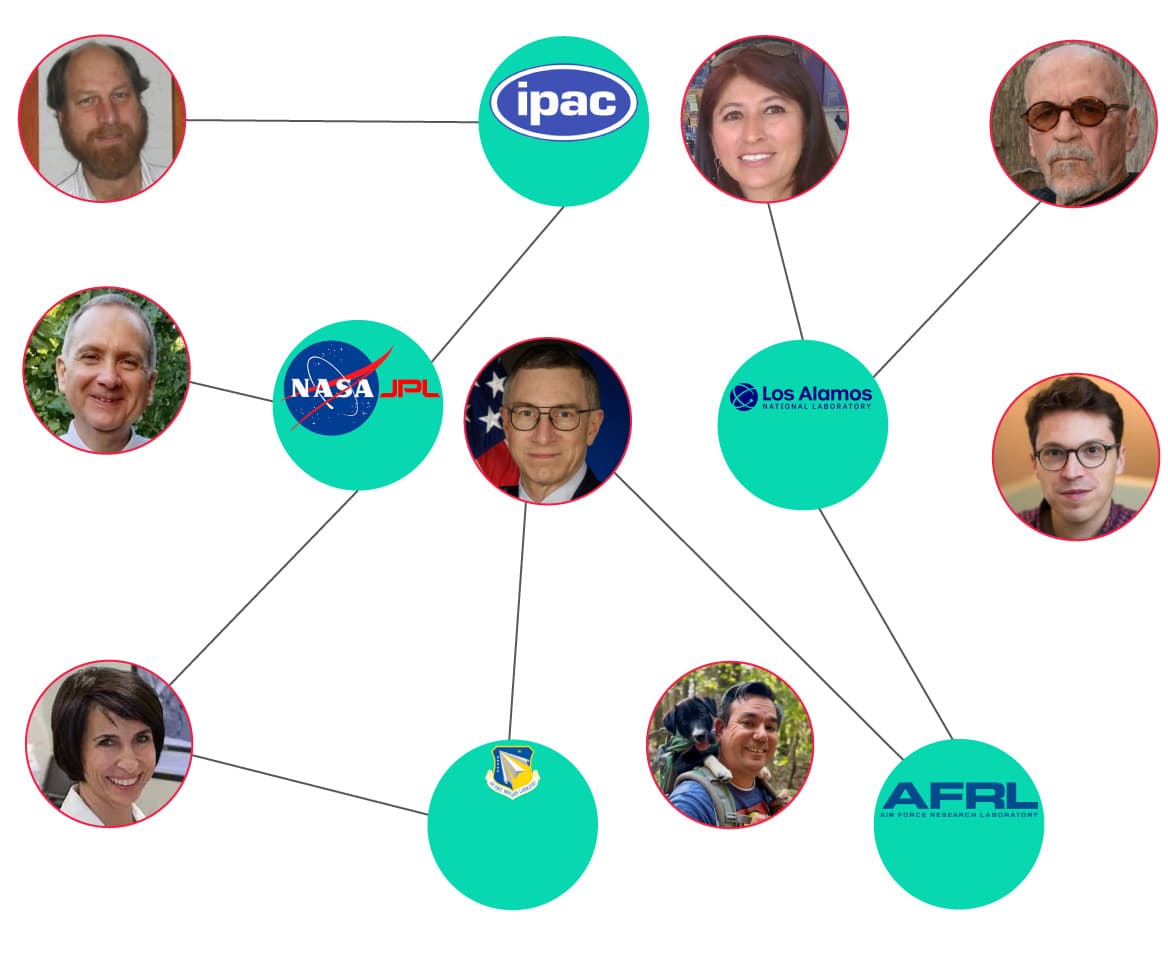
- JPL / LANL / AFRL Scientist Cluster 2023–2026 — Full overview of the nine scientists and defense insiders who died or vanished
- NASA JPL — Organization overview: four JPL-corridor scientists gone in three years
- Frank Maiwald — Longtime JPL coworker; died July 2024; no cause disclosed; Hicks's death extends the JPL cluster back to 2023
- Monica Jacinto Reza — JPL Director of Materials Processing Group; vanished June 2025
- Carl Grillmair — Caltech/IPAC astrophysicist; shot February 2026; same institutional family as Hicks
- William McCasland — Retired USAF Major General, AFRL commander; vanished February 2026; oversaw AFRL budget that funded JPL-adjacent research
- Anthony Chavez — Former LANL employee; vanished May 2025
- Melissa Casias — LANL employee; vanished June 2025
- Nuno Loureiro — MIT plasma physicist; shot December 2025
Other Shocking Stories
- Karl Wolfe: Air Force tech who saw classified lunar photos showing structures — killed by truck while cycling, 2018
- Mark McCandlish: Aerospace illustrator who testified about alien reproduction vehicles — died of shotgun blast days before Senate testimony
- Arie DeGeus: Zero-point energy inventor found dead in car at airport en route to secure major funding
- Philip Leonard: LANL high-explosives chemist killed in head-on crash on the same road to work, 2024
Sources
- Daily Mail: Mystery surrounds death of NINTH scientist tied to US secrets (April 7, 2026)
- Michael David Hicks — University of Arizona LPL In Memoriam
- Michael David Hicks (1964-2023) — University of Arizona LPL News
- Michael Hicks Obituary — Forest Lawn
- Michael C. Hicks — Google Scholar
- THE BLIND SPOT: Rocks Are Falling Through Our Roofs — The Sentinel Network (March 25, 2026)
This information was built by Grok and Claude AI research.
Status: Deceased (2023)
Additional context from the UAP Physics Murders investigation
NASA Jet Propulsion Laboratory astrophysicist and 24-year JPL career researcher who worked on the DART asteroid deflection mission — the first demonstration of kinetic impact as a planetary defense technique, explicitly documented by the Space Force Association as dual-use technology — and died at his Sunland, California home on July 30, 2023, at age 59. No cause of death was publicly released at the time; a coroner record listing cardiovascular disease was found later, but the case was marked as "open."
| Field | Details |
|---|---|
| Full Name | Michael David Hicks |
| Born | February 7, 1964 |
| Died | July 30, 2023, Sunland, California (age 59) |
| Age at Death | 59 |
| Location of Death | Sunland, California (his residence) |
| Cause of Death | Arteriosclerotic cardiovascular disease (per coroner) — no cause released publicly at time of death |
| Official Ruling | Natural (coroner) — case status marked "open" by medical examiner |
| Nationality | American |
| Killed on US Soil | Yes |
| Category | Scientist / Astrophysicist |
| Investigation | Physics |
Assessment: MODERATE SUSPICION
Hicks's death was not immediately flagged as suspicious. The coroner subsequently identified cardiovascular disease as the cause. What draws attention is the combination of factors: no public cause was provided for weeks, the coroner listed the case as "open" despite a natural ruling, Hicks had worked on the DART mission which the Space Force Association described as inherently dual-use, and his death in July 2023 preceded the subsequent documented cluster of deaths among scientists in adjacent domains. His case is included here as the first data point in a pattern that became more legible only in retrospect.
Circumstances of Death
Michael David Hicks died at his residence in Sunland, California on July 30, 2023. He was 59. At the time of his death, Hicks had left JPL approximately one year earlier after a 24-year career; he had been a research scientist there from 1998 through approximately 2022.
No cause of death was made public in the immediate weeks following his death. Early professional memorials and obituaries noted that no cause was given. His memorial service was held on September 30, 2023, at the Will and Ariel Durant Library Community Room in Los Angeles.
His Forest Lawn obituary included a suggestion to donate to al-anon.org, an organization for families affected by alcoholism; the significance, if any, is unknown.
Coroner Record
Subsequent investigative reporting (Newsweek and others covering the broader scientist death pattern) located an LA County Coroner record for Hicks that listed:
- Cause of death: Arteriosclerotic cardiovascular disease (heart disease / blocked arteries)
- Significant condition: Morbid obesity
- Manner of death: Natural
- Case status: "Open" as listed by the medical examiner at the time of reporting
The reason why the cause was not publicly released at the time of death and the reason the case carries "open" status despite a natural ruling have not been publicly explained.
Background
Michael David Hicks was born on February 7, 1964. He earned advanced degrees from Boston University and received his Ph.D. in Lunar and Planetary Science from the University of Arizona's Lunar and Planetary Laboratory in 1997. His doctoral dissertation was titled "A Spectrophotometric Survey of Comets and Earth-Approaching Asteroids."
In 1998, he joined NASA's Jet Propulsion Laboratory as a postdoctoral research associate, transitioning to research scientist. Over 24 years at JPL, he published 80+ peer-reviewed papers in The Planetary Science Journal, Nature, and other journals. He is survived by his daughter Julia, his father Richard, his ex-wife Brunella, and several siblings.
He left JPL approximately one year before his death.
Physics Connections
DART — Dual-Use Kinetic Impactor Technology
The Double Asteroid Redirection Test (DART), managed by the Johns Hopkins Applied Physics Laboratory for NASA's Planetary Defense Coordination Office, launched November 24, 2021, from Vandenberg Space Force Base. On September 26, 2022, the DART spacecraft intentionally impacted Dimorphos — a moonlet of the asteroid Didymos — shortening its orbital period by 32 minutes. This was the first demonstration in human history that kinetic impact can measurably alter an asteroid's trajectory.
Hicks was a member of the DART Science Team.
Dual-use documentation: The Space Force Association explicitly noted that DART technology is "inherently dual use." The same capabilities that deflect an asteroid away from Earth can, in principle, redirect objects toward Earth. The kinetic impactor technology — spacecraft guidance, terminal targeting, impact physics — has documented weapons-relevant characteristics. This dual-use nature was publicly acknowledged in defense policy analysis, not merely inferred.
Spectrophotometric Characterization — Physical Properties of Asteroids and Comets
Hicks's primary scientific specialty was spectrophotometry of near-Earth objects — measuring the surface composition, reflectivity, porosity, and density of asteroids and comets by analyzing their reflected light. This work is prerequisite knowledge for predicting how a kinetic impactor will interact with a specific object: the denser and more coherent the body, the more efficiently momentum transfers; a porous rubble-pile behaves differently from a solid iron body.
Understanding an object's physical response to impact is directly applicable to both:
- Deflecting an asteroid away from Earth (planetary defense)
- Predicting the behavior of a kinetic impactor against another type of target (weapons physics)
Additional Mission Work
- NEAT (Near-Earth Asteroid Tracking Project): Science team member on JPL's ground-based asteroid survey program
- Dawn Mission (asteroid belt): Science team; Dawn orbited Vesta and Ceres, characterizing two large bodies in the main asteroid belt
- NASA Deep Space 1: Science team; a technology demonstrator mission with ion propulsion
Why This Case Raises Questions
- No public cause of death was released at the time of his death — unusual for a scientist at a federal research institution
- The coroner case is listed as "open" despite a natural ruling, with no public explanation provided for the open status
- Hicks left JPL approximately a year before death — the circumstances of his departure are not documented publicly
- His work on DART places him in the dual-use technology domain that has attracted scrutiny in the broader 2023–2026 pattern
- His death in July 2023 coincides with (and precedes) the cluster of deaths among scientists in adjacent fields: Maiwald (July 2024), Reza (June 2025), Casias (June 2025), Chavez (May 2025), Loureiro (December 2025), McCasland (February 2026 disappearance), Grillmair (February 2026)
The Counterargument
- The coroner identified a specific, documented, natural cause: arteriosclerotic cardiovascular disease, with morbid obesity as a contributing condition. This is among the most common causes of death in middle-aged American men.
- An "open" case status in a medical examiner system does not necessarily indicate suspicion — it may reflect pending administrative closure
- Hicks had left JPL approximately a year before his death, and there is no documented indication he was still involved in sensitive research
- No law enforcement investigation was opened; no suspicious circumstances have been identified beyond the pattern inference
- The "cluster" pattern is disputed by authorities who have stated they see no coordinated connection across these deaths
The @TMBSPACESHIPS Diagram Connection
On January 25, 2026 — thirty months after Hicks's death — an anonymous X account called @TMBSPACESHIPS (a self-described 38-year retired USAF PhD engineer with family who worked in classified programs since the mid-1960s) posted a technical diagram labeled "BROWN-CAHILL METHOD for the REDUCTION of KINETIC PERMITTIVITY of FREE SPACE."
The diagram described a plasma-based antigravity propulsion system integrating precisely the subsystems that define the specialties of the 2023–2026 cluster: plasma control (Loureiro), advanced propulsion materials and high-temperature alloys (Reza), dual-use infrared sensor characterization (Grillmair), nuclear/thorium-adjacent power (Chavez, Casias), and AFRL oversight of the full propulsion portfolio (McCasland). Hicks's specialty — characterizing the physical properties of small celestial bodies for kinetic impact prediction — fits the sensor and targeting physics underlying the same propulsion domain.
See William McCasland and Thomas Townsend Brown for full context on the diagram.
Other Shocking Stories
- Carl Grillmair: Caltech planetary defense scientist shot on his rural porch in February 2026 — eleven weeks after his alleged killer was arrested on his property with a loaded rifle, and eleven days after gun charges were dismissed.
- Nuno Loureiro: MIT plasma physicist and fusion center director shot at his home December 2025.
- Frank Maiwald: NASA JPL senior RF engineer with dual-use defense work died July 4, 2024 — cause of death never released, no autopsy.
- William McCasland: AFRL commander overseeing propulsion R&D disappeared Feb 27, 2026.
See Also
- Carl Grillmair — JPL/Caltech planetary defense scientist shot February 2026; parallel dual-use profile
- Frank Maiwald — NASA JPL senior RF engineer with dual-use defense instruments; died July 2024, no cause ever released
- William McCasland — AFRL commander overseeing the propulsion domains described in the @TMBSPACESHIPS diagram; missing Feb 2026
- Monica Jacinto Reza — Advanced propulsion materials scientist; vanished June 2025; funded under McCasland's AFRL budget
- Electromagnetic_Propulsion — Theoretical framework connected to the @TMBSPACESHIPS Brown-Cahill diagram
- Thomas Townsend Brown — "Brown" in the Brown-Cahill Method; pioneer of electrogravitics; classified after 1956
- Michael David Hicks (UAP Deaths) — Profile emphasizing the UAP-cluster context
Sources
- AAS Division for Planetary Sciences memorial
- Lunar and Planetary Laboratory, University of Arizona memorial
- Forest Lawn obituary
- Newsweek — coroner findings and the broader scientist death list
- Newsweek — list of suspicious scientist deaths
- NewsNation — UAP context
- Yahoo News — growing list of dead/missing NASA scientists
- @TMBSPACESHIPS Brown-Cahill Method diagram on X — Jan 25, 2026
Status: Deceased (2023)
This information was compiled by Claude AI research.
Investigations: UAPs Murders (General), UAP Physics Murders