Edward J. Ruppelt
First director of Project Blue Book and the man who coined the term "unidentified flying object," dead of a heart attack at 37.
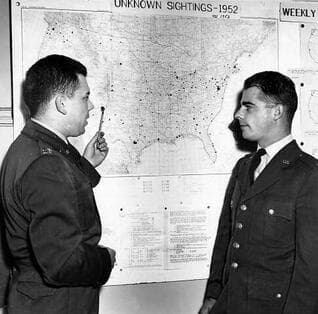
| Field | Details |
|---|---|
| Full Name | Edward James Ruppelt |
| Born | July 17, 1923 |
| Died | September 15, 1960 |
| Age at Death | 37 |
| Location of Death | Long Beach, California |
| Cause of Death | Heart attack (second occurrence) |
| Official Ruling | Natural causes |
| Category | Military / Government UFO Investigator |
Assessment: SUSPICIOUS
Ruppelt's death at 37 from a "sudden" heart attack raises questions primarily because of his age, his role as the most important early government UFO investigator, and the fact that he had recently added three debunking chapters to the revised edition of his book — chapters that contradicted the more open-minded original edition. Some researchers have speculated he was pressured to add those chapters and that his change of position may have put him in a complicated situation with both sides of the UFO debate.
Circumstances of Death
Ruppelt suffered a second heart attack and died on September 15, 1960, in Long Beach, California. A local newspaper referred to his death as "sudden." He had experienced a first heart attack shortly before, but had apparently been recovering. He was only 37 years old.
Background
Edward Ruppelt served as a bombardier-navigator in World War II, flying combat missions in the Pacific theater. After the war, he joined the Air Force's intelligence division and was assigned to investigate UFO reports.
In 1951, Ruppelt took over Project Grudge, the Air Force's UFO investigation program, and reorganized it into Project Blue Book in March 1952. He is generally credited with coining the term "unidentified flying object" (UFO) to replace the more sensational "flying saucer" and "flying disk."
Under Ruppelt's leadership, Blue Book took a more scientific approach to UFO investigations. He established a standardized reporting system, consulted with scientists, and treated UFO reports seriously. He left Blue Book in late 1953.
In 1956, Ruppelt published The Report on Unidentified Flying Objects, which is considered one of the most balanced and credible government insider accounts of the UFO phenomenon. The original edition acknowledged that many UFO cases remained genuinely unexplained.
However, in 1960, a revised edition was published with three additional chapters that took a much more dismissive tone toward UFOs, essentially debunking the phenomenon. The shift was so dramatic that many in the UFO community believed Ruppelt had been pressured by the Air Force to add the debunking material. Ruppelt died shortly after the revised edition was published.
Why This Death Possibly Raises Questions
- Death at age 37 from a heart attack is statistically unusual, though not impossible
- He was the most knowledgeable government insider regarding UFO evidence from the early 1950s
- The timing — dying shortly after publishing a revised edition that contradicted his earlier, more open-minded work — has been noted by researchers
- The dramatic reversal in his book's tone between the 1956 and 1960 editions suggests possible external pressure
- No evidence of foul play has been documented; heart disease at young ages does occur naturally
- Some researchers have placed his death in the context of Otto Binder's list of 137 UFO researchers who died in the 1960s
Key Quotes from Media Coverage
In what one newspaper referred to as a "sudden" death, Ruppelt suffered a second heart attack at age 37.
See Also
- J. Allen Hynek — Scientific consultant to Project Blue Book
- James McDonald — Examined Blue Book files and found systematic mishandling of evidence
- Thomas Mantell — Early UFO case investigated under Ruppelt's predecessor programs
Other Shocking Stories
- John Brittan: Royal College of Military Science IT specialist found dead from carbon monoxide poisoning in his garage — had...
- Robert Frost (Area 51 Worker): Civilian contractor at Groom Lake (Area 51) who died at age 57 after his tissues were found to...
- Morris K. Jessup: Astronomer and UFO author who investigated antigravity and the Philadelphia Experiment, found dead in his car under disputed...
- Eugene Mallove: Cold fusion advocate, science writer, and editor of Infinite Energy magazine who was beaten to death in 2004...
Sources
- Edward J. Ruppelt — Wikipedia
- Edward James Ruppelt — First Director of Project Blue Book — Enigma Labs
- Edward J. Ruppelt — The UFO Database
- Edward Ruppelt: 7 Untold Secrets of Project Blue Book's First Director — UAP Watchers
- CPT Edward James Ruppelt — Find a Grave
This information was built by Grok and Claude AI research.
Status: Deceased (1960)
Additional context from the UAP Physics Murders investigation
First director of Project Blue Book, the man who coined the term "unidentified flying object," and author of the most authoritative government insider account of UFO investigations, who died of a heart attack at age 37 -- just months after publishing a revised edition of his book that reversed his earlier conclusions under circumstances many researchers believe involved government pressure.
| Field | Details |
|---|---|
| Full Name | Edward James Ruppelt |
| Born | July 17, 1923, Grundy Center, Iowa |
| Died | September 15, 1960, Long Beach, California (age 37) |
| Cause of Death | Heart attack (second occurrence), officially natural causes |
| Role | U.S. Air Force Officer / Project Blue Book Director / Author |
| Affiliation | United States Air Force; Northrop Aircraft Company (post-military) |
| Education | B.S. Aeronautical Engineering, Iowa State College (1951) |
| Military Service | U.S. Army Air Corps / U.S. Air Force, 1942--1953; B-29 bombardier and radar operator, Pacific Theater, WWII |
| Decorations | Two Distinguished Flying Crosses, three Air Medals, five battle stars, two theater combat ribbons |
| Notable Work | The Report on Unidentified Flying Objects (1956; revised edition 1960) |
Biography
Edward James Ruppelt was born on July 17, 1923, in Grundy Center, Iowa. He enlisted in the Army Air Corps in 1942 during World War II and served as a B-29 bombardier and radar operator, flying combat missions over India, China, and the Pacific with one of the original B-29 wings. His combat service was distinguished: he earned two Distinguished Flying Crosses, three Air Medals, five battle stars, and two theater combat ribbons -- an exceptional record for a young airman.
After the war, Ruppelt attended Iowa State College, where he earned a Bachelor of Science degree in aeronautical engineering in 1951. He continued his career in the Air Force and was assigned to the Air Technical Intelligence Center (ATIC) at Wright-Patterson Air Force Base in Dayton, Ohio, where he became involved in the military's UFO investigation programs.
Project Blue Book: The Golden Age
In late 1951, Ruppelt was assigned to take over Project Grudge, the Air Force's flagging and demoralized UFO investigation program. Under his leadership, the project was reorganized and renamed Project Blue Book in March 1952. Ruppelt transformed the program from a dismissive bureaucratic exercise into a genuine scientific investigation.
Coining the Term "UFO"
Ruppelt is generally credited with coining the term "unidentified flying object" to replace the popular terms "flying saucer" and "flying disk." He made this change because the military considered those terms misleading when applied to objects of every conceivable shape and performance characteristic. The acronym "UFO" -- later universally adopted -- became the standard terminology for the phenomenon and remained in common use until the U.S. government's recent shift to "unidentified aerial phenomena" (UAP) and then "unidentified anomalous phenomena."
Investigation Methodology
Ruppelt established rigorous investigation standards that represented the most serious government effort to study UFOs up to that time:
- Standardized questionnaires: He introduced uniform reporting forms for witnesses, enabling systematic data collection and cross-case comparison for the first time.
- Direct access to witnesses: During most of Ruppelt's tenure, he and his team were authorized to interview any military personnel who witnessed UFOs without following the normal chain of command -- unprecedented authority that underlined the seriousness of the investigation.
- Blue Book officers: Each U.S. Air Force base had a designated Blue Book officer responsible for collecting UFO reports and forwarding them to Ruppelt's team at Wright-Patterson.
- Scientific consultation: Ruppelt brought in outside scientific advisors, including astronomer J. Allen Hynek, who served as the project's scientific consultant and would later become the most prominent academic UFO researcher of his generation.
- Statistical analysis: The Battelle Memorial Institute was commissioned to conduct a statistical study of UFO reports (later published as "Project Blue Book Special Report No. 14"), applying rigorous analytical methods to the accumulated data.
UFO researcher Jerome Clark wrote that "Most observers of Blue Book agree that the Ruppelt years comprised the project's golden age, when investigations were most capably directed and conducted. Ruppelt was open-minded about UFOs, and his investigators were not known, as Grudge's were, for force-fitting explanations on cases."
Major Cases During Ruppelt's Tenure
Ruppelt oversaw the investigation of several of the most significant UFO incidents of the era, including the July 1952 Washington, D.C. UFO wave, in which unidentified objects were tracked on radar over the nation's capital on consecutive weekends and pursued by jet interceptors. He also dealt with the Lubbock Lights case, the Nash-Fortenberry sighting, and numerous reports from military pilots and radar operators.
Ruppelt left Project Blue Book in late 1953. After his departure, the project's investigative rigor declined significantly. Blue Book increasingly became a public relations operation aimed at explaining away sightings rather than investigating them -- a trajectory that J. Allen Hynek would later publicly criticize and that James McDonald would expose through his own examination of the Blue Book files.
The Report on Unidentified Flying Objects (1956)
After leaving the Air Force, Ruppelt worked as a research engineer at Northrop Aircraft Company in the aerospace industry. In 1956, he published The Report on Unidentified Flying Objects, a detailed account of his experiences directing Blue Book and the evidence he had encountered.
The book was remarkable for several reasons:
- Government insider perspective: It was the first comprehensive account of the government's UFO investigation program written by the person who had actually directed it.
- Balanced and honest tone: Ruppelt did not claim that UFOs were definitively extraterrestrial, but he acknowledged that many cases remained genuinely unexplained and could not be attributed to misidentification, hoaxes, or natural phenomena.
- Detailed case studies: The book presented numerous well-documented UFO incidents, including cases involving multiple credible witnesses, radar confirmation, and physical evidence.
- Institutional critique: Ruppelt described the internal politics, bureaucratic resistance, and institutional biases that hampered serious UFO investigation within the Air Force.
The book became one of the most respected and widely cited works in UFO literature. Its measured tone and insider authority gave it credibility that purely civilian UFO books lacked. Researchers including James McDonald and J. Allen Hynek regarded it as an essential document in the history of UFO investigation.
The Revised Edition and the Reversal (1960)
In 1960, a revised edition of The Report on Unidentified Flying Objects was published with three additional chapters. These new chapters represented a dramatic reversal of Ruppelt's earlier position. Where the 1956 edition had been open-minded and acknowledged genuinely unexplained cases, the 1960 additions took a dismissive tone and attempted to debunk the UFO phenomenon.
The shift was so stark that it raised immediate questions within the UFO research community. The original fourteen chapters presented a careful, balanced assessment; the three added chapters read as though written by a different person with a fundamentally different perspective on the evidence.
Questions About the Reversal
Several factors have led researchers to question whether Ruppelt's reversal was genuinely his own:
- Tonal inconsistency: The debunking chapters contradicted not only the spirit but in some cases the specific factual claims of the original text, suggesting they may have been written or influenced by someone other than the author of the original edition.
- Timing: The revised edition appeared during a period when the Air Force was actively working to minimize public interest in UFOs, following the 1953 Robertson Panel's recommendation that the government should undertake a public education campaign to "debunk" UFO reports.
- Ruppelt's health: By 1960, Ruppelt had already suffered his first heart attack and was in declining health, potentially making him more vulnerable to institutional pressure.
- Career considerations: Ruppelt was working in the defense aerospace industry at Northrop Aircraft Company, where maintaining good relations with the Air Force would have been professionally important.
No definitive evidence has been made public proving that Ruppelt was coerced into adding the debunking chapters. However, the abruptness and completeness of the reversal -- from one of the most credible pro-investigation voices to a dismissive debunker -- remains one of the more puzzling episodes in UFO history.
Death Circumstances
Ruppelt suffered a heart attack sometime before 1960 but had apparently been recovering. He then suffered a second heart attack and died on September 15, 1960, in Long Beach, California. He was 37 years old. A local newspaper described his death as "sudden."
Why This Death Raises Questions
- Age: Death from a heart attack at age 37 is statistically unusual, though not impossible. Congenital heart conditions and other factors can cause cardiac events in young adults.
- Timing: Ruppelt died shortly after the publication of the revised edition that reversed his public position on UFOs. He was the single most knowledgeable government insider regarding UFO evidence from the early 1950s.
- The reversal context: Some researchers have placed Ruppelt's death alongside the broader pattern of UFO researchers and insiders who changed their positions or died under notable circumstances during the late 1950s and 1960s. Researcher Otto Binder compiled a list of 137 UFO researchers who died during the 1960s, and Ruppelt's case is sometimes cited in that context.
- No evidence of foul play: It must be stated clearly that no evidence of foul play has been documented in connection with Ruppelt's death. Heart disease at young ages does occur naturally, and two heart attacks in succession is a recognized medical pattern.
Assessment
Ruppelt's death is best characterized as a case where the circumstances are notable but not conclusive of anything beyond natural causes. The combination of his young age, his unique insider knowledge, and the timing relative to his public reversal on UFOs makes it a case that researchers have continued to discuss, but the available evidence does not support claims of foul play.
Legacy
Edward Ruppelt's contributions to the study of unidentified flying objects were foundational and enduring:
The terminology he created persists. The term "UFO," which Ruppelt coined, became the universal designation for the phenomenon for over seven decades. Even now that government agencies have adopted "UAP," the term "UFO" remains embedded in popular culture and common usage worldwide.
His investigation methodology set the standard. The systematic approach Ruppelt brought to Blue Book -- standardized reporting, direct witness access, scientific consultation, and statistical analysis -- established the template for how UFO investigations should be conducted. Later researchers, including J. Allen Hynek and James McDonald, built directly on the framework Ruppelt created.
His book remains essential reading. The original 1956 edition of The Report on Unidentified Flying Objects is still regarded as one of the most important works in UFO literature. It has been reprinted numerous times and is available through Project Gutenberg. Modern editions typically include only the original fourteen chapters, restoring the text to what most researchers consider Ruppelt's authentic position.
His case illustrates the cost of insider disclosure. Whether or not Ruppelt was directly pressured to reverse his position, his trajectory -- from open-minded investigation to public debunking to early death -- is cited by UAP disclosure advocates as an example of the personal toll that can accompany government UFO involvement. His experience foreshadowed the difficulties faced by later government insiders who attempted to speak publicly about the phenomenon.
Project Blue Book's legacy. The program Ruppelt built continued in diminished form until 1969, when it was closed following the Condon Report's recommendation. The gap between Blue Book's rigorous early period under Ruppelt and its later decline into a public relations exercise became a central argument for critics who maintained that the government was not seriously investigating UFOs -- an argument that persisted until the revelation of the Advanced Aerospace Threat Identification Program (AATIP) in 2017.
Related Perspectives
- J. Allen Hynek -- Scientific consultant to Project Blue Book during Ruppelt's tenure, who later became the most prominent academic UFO researcher
- James McDonald -- Atmospheric physicist who examined Blue Book files and found systematic mishandling of evidence after Ruppelt's departure
- Frank Edwards -- Broadcaster and author who popularized UFO research in the 1950s and 1960s, and who also died of a heart attack under notable timing
- Stanton Friedman -- Nuclear physicist and UFO researcher who continued the tradition of credentialed scientific investigation that Ruppelt helped establish
- Morris Jessup -- UFO author and researcher of the same era whose death was ruled a suicide under disputed circumstances
Sources
- Edward J. Ruppelt -- Wikipedia
- Edward James Ruppelt -- First Director of Project Blue Book -- Enigma Labs
- Edward Ruppelt: 7 Untold Secrets of Project Blue Book's First Director -- UAP Watchers
- Captain Edward J. Ruppelt: The Man Behind Project Blue Book -- Project Blue Blog
- The Report on Unidentified Flying Objects -- Wikipedia
- The Report on Unidentified Flying Objects -- Project Gutenberg
- Project Blue Book -- Wikipedia
- Edward J. Ruppelt -- Military Wiki
This information was compiled by Claude AI research.
Status: Deceased (1960)
Investigations: UAPs Murders (General), UAP Physics Murders