Thomas Townsend Brown
American inventor and physicist who pioneered electrogravitics research and the Biefeld-Brown effect; died of natural causes in 1985 after decades of semi-retirement.
| Field | Details |
|---|---|
| Full Name | Thomas Townsend Brown |
| Born | March 18, 1905 (Zanesville, Ohio, USA) |
| Died | October 27, 1985 |
| Age at Death | 80 |
| Location of Death | Los Angeles County, California, USA |
| Cause of Death | Not publicly recorded (natural causes presumed) |
| Official Ruling | Natural causes |
| Category | Physicist / Inventor / Electrogravitics Researcher |
Video Evidence
Amy Eskridge — murdered antigravity researcher (2022) — cited T. Townsend Brown as one of the people who independently discovered antigravity, suppressed by the US government each time. Source: @UAPLuigi on X, April 29, 2026.
Assessment: NOT SUSPICIOUS
Thomas Townsend Brown died at age 80 in 1985 after spending his later years in semi-retirement in California. His death received minimal public notice, consistent with his decades-long withdrawal from prominence. There are no credible reports of foul play, threats, or suspicious circumstances surrounding his death. While his research into electrogravitics and antigravity touched on subjects later associated with UAP/UFO technology, Brown lived a long life and appears to have died of natural causes at an advanced age.
Circumstances of Death
Thomas Townsend Brown died on October 27, 1985, in Los Angeles County, California. The specific cause of death was not publicly recorded or widely reported. He was interred at Avalon Cemetery on Catalina Island. His passing received minimal contemporary notice, reflecting his years of withdrawal from public life and the scientific mainstream.
Background
Thomas Townsend Brown was an American inventor and physicist whose work on the relationship between electricity and gravity led to a lifetime of research into what he believed was an antigravity effect. In 1921, while still a high school student experimenting in a laboratory his parents had set up for him, Brown discovered an unusual effect while working with a Coolidge tube (a type of X-ray vacuum tube with asymmetrical electrodes). He observed what he interpreted as a gravitational effect produced by high-voltage electrical fields.
This discovery led Brown to develop the concept of "electrogravitics" and the "Biefeld-Brown effect," named after himself and his professor, Paul Alfred Biefeld, at Denison University. Brown spent decades developing devices based on these principles and promoting them for use by industry and the military.
Brown's work attracted interest from the US Navy, and there were investigations into his claims during the 1950s. However, mainstream science generally attributed the observed effects to ionic wind (electrohydrodynamics) -- the movement of charged particles transferring momentum to surrounding neutral air particles -- rather than any antigravity phenomenon.
Brown's electrogravitics research has been retroactively connected to UAP/UFO technology discussions. Some researchers in the UAP field have speculated that Brown's work was classified and continued in secret programs, though this remains unconfirmed. His research is frequently cited in discussions about potential propulsion systems for the craft described in UFO reports.
For most of his later life, Brown lived in semi-retirement in California, continuing private experiments but largely removed from public scientific discourse.
Why This Death Possibly Raises Questions
- Brown's death does not raise significant questions regarding foul play
- He was 80 years old and had been in semi-retirement for years
- No reports of threats, warnings, or suspicious circumstances
- His research, while potentially significant, had been largely marginalized by the scientific mainstream decades before his death
- His work is relevant to the UAP discussion primarily in a historical and theoretical context
See Also
- Thomas Townsend Brown (Zero Point Energy) — This case also appears in the Zero Point Energy project
- Nikola Tesla — Pioneer of electromagnetic technology whose papers were seized after death
- Bruce DePalma — N-Machine inventor who died before scheduled testing
- Floyd Sweet — Free energy inventor whose research materials were confiscated after death
- Ning Li — Antigravity researcher whose DOD-funded results were never published
Other Shocking Stories
- Karl Wolfe: Former US Air Force sergeant and Disclosure Project witness who claimed he saw NASA photos of alien structures...
- Stefan Marinov: Bulgarian physicist who fell to his death from a university library staircase in Graz, Austria in 1997 while...
- Amy Eskridge: Multidisciplinary scientist and co-founder of the Institute for Exotic Science in Huntsville, Alabama, who was found dead from...
- Trevor Knight: Marconi computer engineer found dead from carbon monoxide poisoning with a hosepipe connected to his car exhaust —...
Sources
- Thomas Townsend Brown - Wikipedia
- Thomas Townsend Brown - Encyclopedia MDPI
- Thomas Townsend Brown - Find a Grave Memorial
- Thomas Townsend Brown - WikiTree
- Grokipedia - Thomas Townsend Brown
This information was built by Grok and Claude AI research.
Status: Deceased (1985)
Additional context from the UAP Energy Systems Murders investigation
American physicist who discovered the Biefeld-Brown effect (electrogravitics), proposed antigravity propulsion to the U.S. military, and reportedly had his research classified and suppressed.
| Field | Details |
|---|---|
| Full Name | Thomas Townsend Brown |
| Born | March 18, 1905 |
| Died | October 27, 1985 |
| Age at Death | 80 |
| Location of Death | Catalina Island, Los Angeles County, California |
| Cause of Death | Not publicly detailed |
| Official Ruling | Natural causes |
| Category | Energy Inventor / Physicist / Scientist |
Video Evidence
Amy Eskridge — murdered antigravity researcher (2022) — cited T. Townsend Brown as one of the people who independently discovered antigravity, suppressed by the US government each time. Source: @UAPLuigi on X, April 29, 2026.
Assessment: RESEARCH CLASSIFIED
Thomas Townsend Brown was not murdered — he died at age 80 on Catalina Island, California, where he had spent his final years peacefully with family. However, his case is significant because his electrogravitic research was allegedly classified by the U.S. military after he submitted Project Winterhaven in 1952. Brown spent decades demonstrating that high-voltage asymmetric capacitors could produce thrust, which he interpreted as an interaction between electricity and gravity. The mainstream scientific community attributed the effect to ionic wind (electrohydrodynamics), but Brown's supporters contend that classified programs used his work for advanced aerospace applications — with some claiming the B-2 stealth bomber incorporates electrogravitic technology. Whether or not the physics is valid, the documented classification of electrogravitic research by 1957 represents a clear case of government suppression of a research direction.
Circumstances of Death
In the early 1980s, Brown and his wife moved to Catalina Island, California, where their daughter Linda and her family lived. Brown spent his final years there in relative peace, occasionally discussing physics with anyone willing to listen and spending time with his grandchildren. He died on October 27, 1985, at the age of 80. He was interred at Avalon Cemetery on Catalina Island.
His death was not suspicious in itself — Brown was elderly and had been in declining health. The significance of his case lies entirely in what happened to his research during his lifetime.
Background
Early Discovery
Brown first observed the Biefeld-Brown effect as a student at Denison University in the 1920s, working under physicist Paul Alfred Biefeld. He noticed that a high-voltage asymmetric capacitor — one with electrodes of different sizes — produced a net thrust toward the smaller electrode when energized. Brown interpreted this as evidence that electricity could interact with gravity, producing a propulsive force without conventional reaction mass.
Throughout the 1920s and 1930s, Brown refined his experiments and filed patents for devices he described as utilizing electrogravitic propulsion.
Navy Service
Brown enlisted in the United States Navy in 1930 as an apprentice seaman. Based on his background in experimental electrical research, he was assigned to the United States Naval Research Laboratory in March 1931. He served in dual roles as both a sailor and a research assistant, participating in the 1932 Navy-Princeton gravity expedition to the West Indies aboard submarine S-48.
During World War II, Brown contributed to classified naval research under the Bureau of Ships, working on degaussing techniques to protect ships from magnetic mines and on acoustic mine-sweeping systems using pulsed electromagnetic fields. He held the rank of lieutenant in the naval reserve.
Project Winterhaven
In 1952, Brown submitted Project Winterhaven to the U.S. military — a proposal for the development of disc-shaped aircraft using electrogravitic propulsion. The proposal outlined how high-voltage asymmetric capacitors could theoretically be used to propel mach-3 disc-shaped fighter aircraft without conventional engines or propellant.
According to multiple sources, Project Winterhaven was classified by the Air Force. A 1956 report prepared by Aviation Studies (International) Ltd., the Gravity Research Group, and the Special Weapons Study Unit in England defined electrogravitics as "a synthesis of electrostatic energy use for propulsion" and noted its origins in Brown's postwar work. The classification of this report underscores the military's interest in the subject.
Alleged Suppression
By 1957, according to researchers in the field, electrogravitics had become a classified subject. Brown's public research effectively ended, and he spent subsequent decades working in isolation without significant institutional support.
Some accounts claim that Brown received what has been described as a "hush-money pension" from Northrop Corporation beginning in 1967, allegedly in exchange for ceasing public discussion of electrogravitic propulsion. This claim has not been independently verified.
The Ionic Wind Debate
The mainstream scientific community has attributed the Biefeld-Brown effect to electrohydrodynamics — specifically, ionic wind. When high voltage is applied to an asymmetric capacitor in air, it ionizes air molecules near the sharp electrode, and these ions transfer momentum to surrounding neutral air molecules as they accelerate toward the larger electrode, producing thrust. This explanation does not require any novel gravitational interaction.
Brown conducted experiments in vacuum chambers that he claimed showed thrust persisting even without air, which would contradict the ionic wind explanation. However, these vacuum experiments were never independently replicated to the satisfaction of the broader scientific community.
A 2002 U.S. Army Research Laboratory paper by Thomas Bahder and Chris Fazi studied the effect and concluded that the observed force was consistent with ionic wind, not antigravity.
Why This Case Raises Questions
- Project Winterhaven was submitted to the U.S. military in 1952 and was allegedly classified — the classification itself suggests the military saw potential in the research
- Electrogravitics reportedly became a classified subject by 1957, effectively removing it from open scientific inquiry
- Brown's Navy career and security clearances gave him access to classified programs, and his subsequent silence is consistent with classification restrictions
- The alleged Northrop pension, if true, suggests a major defense contractor had interest in keeping Brown quiet about what he knew
- Claims persist that the B-2 stealth bomber incorporates electrogravitic technology, based on the aircraft's unusual design features and charging systems
- Brown conducted his later research in isolation and poverty, despite the potential military significance of his work — a pattern consistent with suppression
- The 1956 Aviation Studies report on electrogravitics was itself classified, indicating governmental interest in controlling information about the field
The Counterargument
- The Biefeld-Brown effect has been convincingly explained as ionic wind by mainstream physics, including the 2002 U.S. Army Research Laboratory study
- Brown's vacuum experiments were never independently replicated
- No peer-reviewed physics journal has confirmed an electrogravitic effect
- The classification of Project Winterhaven may simply reflect routine military caution about any propulsion proposal, not confirmation of its validity
- Brown's declining career may reflect the scientific community's legitimate assessment that his work was based on a misunderstanding of electrohydrodynamics
- The Northrop pension claim is unverified
- Many fringe technologies attract military classification reviews without being valid
Key Quotes
"Electrogravitics had its birth after the War, when Townsend Brown sought to improve on the various proposals that then existed for electrostatic motors sufficiently to produce some visible manifestation of sustained motion." — Aviation Studies (International) Ltd., 1956 classified report
See Also
- Nikola Tesla — Inventor whose papers were seized by the government and whose wireless energy research was defunded
- Philo Farnsworth — Television and fusion inventor whose fusor research was defunded by ITT
- Thomas Henry Moray — Radiant energy inventor whose lab was ransacked
- John Bedini — Free energy inventor who died of an apparent heart attack
- Otis T. Carr — Tesla protege who claimed to build antigravity craft. Arrested before demonstration, equipment confiscated, died penniless
- Thomas Townsend Brown (UAP Deaths project) — Parallel profile in UAP Deaths project
Other Shocking Stories
- Rory Johnson: DOE issued gag and grab orders on his magnetic motor. Fled at midnight. Died in California.
- Al Wordsworth: Built overunity generator (3A in, 32A out). Both devices confiscated. Never returned.
- Richard Pugh: MOD consultant found with feet bound, plastic bag on head, rope around body. Ruled "accident."
- Shani Warren: Found drowned, gagged, and bound. Police ruled it suicide. Convicted as murder 35 years later.
Sources
- Thomas Townsend Brown — Wikipedia
- Biefeld-Brown Effect — Wikipedia
- Thomas Townsend Brown — Encyclopedia MDPI
- Thomas Townsend Brown — ttbrown.com
- Force on an Asymmetric Capacitor — U.S. Army Research Laboratory (Bahder & Fazi, 2002)
- Thomas Townsend Brown — Stephen M. Walker II Research
This information was built by Grok and Claude AI research.
Status: Deceased (1985)
Additional context from the UAP Physics Murders investigation
Pioneer of electrogravitics who discovered the Biefeld-Brown effect in the 1920s — demonstrating anomalous thrust from high-voltage asymmetric capacitors — and spent six decades developing what he believed was a coupling between electromagnetism and gravity.
| Field | Details |
|---|---|
| Full Name | Thomas Townsend Brown |
| Born | March 18, 1905 (Zanesville, Ohio) |
| Died | October 27, 1985 (Los Angeles County, California) |
| Role | Physicist / Inventor / Electrogravitics Researcher |
| Platform | Laboratory experiments, military proposals, classified research programs |
| Notable Works | Discovery of the Biefeld-Brown effect (1920s); "How I Control Gravitation" (1929, Science & Invention); Project Winterhaven proposal (1952); Bahnson Lab experiments (1958-1960); US Patents 2,949,550; 3,018,394; 3,022,430; 3,187,206 |
| Evidence Rating | MODERATE EVIDENCE |
Video Evidence
Amy Eskridge — murdered antigravity researcher (2022) — cited T. Townsend Brown (the pioneer of the Biefeld-Brown effect and electrogravitics) as one of the people who independently discovered antigravity, suppressed by the US government each time. Source: @UAPLuigi on X, April 29, 2026.
Their Claims
Thomas Townsend Brown claimed that high-voltage direct current applied to asymmetric capacitor configurations produced a net propulsive force that could not be fully explained by ionic wind or electrohydrodynamic effects alone. He interpreted this force as evidence of a direct coupling between electromagnetic fields and gravity — a phenomenon he called "electrogravitics."
Brown first observed this effect in the early 1920s while still a high school student, experimenting with a Coolidge X-ray tube. When he placed the tube on a sensitive scale and applied high voltage, he noticed a measurable weight change that varied depending on the tube's orientation relative to gravity. The effect was consistent and repeatable: the device always exhibited a force toward the positive (smaller) electrode.
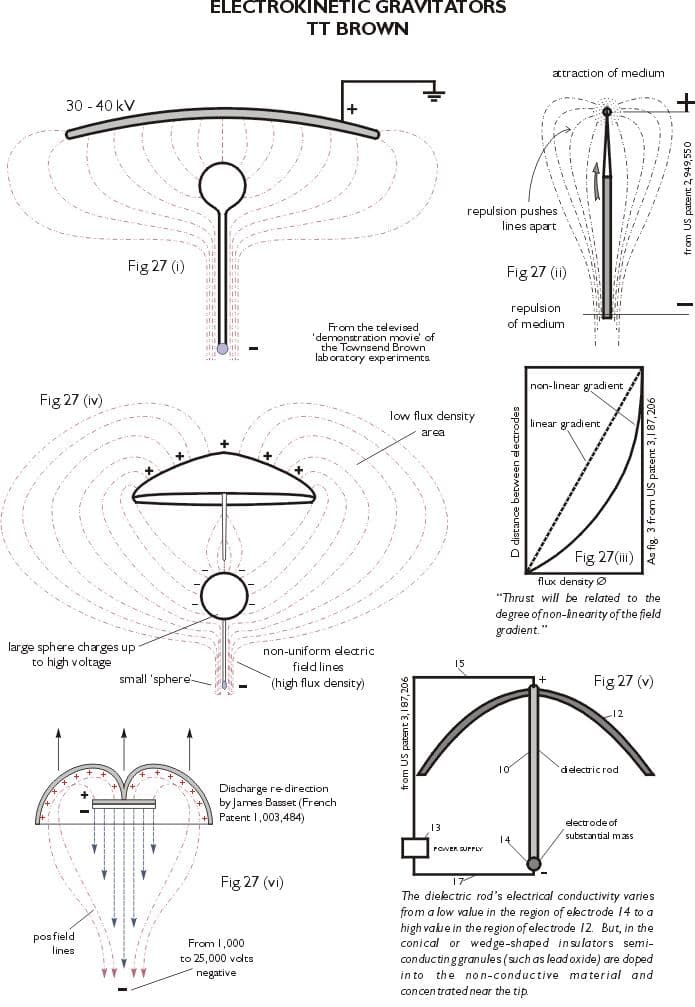
Over the following decades, Brown refined the effect into increasingly sophisticated devices. His "gravitators" were flat capacitor plates charged to 25,000-200,000 volts DC that exhibited a net thrust toward the smaller positive electrode. In the 1950s, he progressed to disc-shaped devices that could be suspended and rotated, demonstrating thrust in vacuum conditions — a critical test, since ionic wind (the mainstream explanation) should vanish in vacuum.
In 1952, Brown submitted Project Winterhaven to the Pentagon, proposing the development of a Mach-3 electrogravitic combat disc based on his research. The proposal received serious military consideration. By 1955-1956, every major US aerospace contractor — Convair, Martin, Bell, Douglas, Lear, and others — was conducting electrogravitics research, as documented in two classified intelligence reports: "Electrogravitics Systems" (February 1956) and "The Gravitics Situation" (December 1956). Then, around 1957, the entire subject abruptly vanished from the public record.
Brown continued private experiments for the rest of his life, conducting research in France in the 1950s (reportedly for the French military) and at the Bahnson Laboratory in North Carolina (1958-1960). He spent his later years in semi-retirement in California, largely removed from public scientific discourse.
Key Quotes
"I have found that a force can be produced by electrical means which has no conventional explanation." — Thomas Townsend Brown, from experimental notes
"The Biefeld-Brown effect produces a net force on an asymmetric capacitor when charged to high voltages. The force is not adequately explained by known electrostatic or aerodynamic effects." — Summary of Brown's experimental claims across multiple decades
Key Arguments & Evidence They Cite
- Coolidge tube observations (1920s): High-voltage X-ray tubes showed measurable weight changes on scales, varying by orientation — suggesting a force coupling between electrical charge and gravity
- Gravitator devices (1930s-1950s): Flat asymmetric capacitor plates charged to 25,000-200,000 volts exhibited consistent, repeatable thrust toward the positive electrode
- Disc experiments (1950s): Disc-shaped devices suspended on arms rotated under high voltage, demonstrating angular thrust. Brown claimed these worked in vacuum, though this remains disputed
- Project Winterhaven (1952): Formal military proposal for Mach-3 combat disc based on electrogravitics, taken seriously enough to receive classified evaluation
- Industry-wide research (1955-1957): Two classified intelligence reports documented every major aerospace contractor conducting electrogravitics research before the subject abruptly disappeared from public discourse
- French experiments (1955-1956): Brown conducted tests for French military authorities, reportedly demonstrating effects that could not be fully attributed to ionic wind
- Bahnson Laboratory experiments (1958-1960): Continued controlled testing at a private lab in North Carolina
- Multiple US patents: Patents 2,949,550; 3,018,394; 3,022,430; and 3,187,206 describe electrogravitic devices and methods
The Physics
The Biefeld-Brown Effect
The core phenomenon involves applying high DC voltage (25,000+ volts) across an asymmetric capacitor — where one electrode is much larger than the other. The device exhibits a net force toward the smaller (positive) electrode. Brown and his mentor Paul Alfred Biefeld at Denison University documented this effect extensively starting in the 1920s.
Mainstream Explanation: Ionic Wind
Mainstream physics attributes the Biefeld-Brown effect entirely to electrohydrodynamics (ionic wind). When high voltage ionizes air molecules near the sharp electrode, the resulting ions accelerate toward the larger electrode, transferring momentum to neutral air molecules and creating a net aerodynamic thrust. A 2003 Army Research Laboratory study by Thomas Bahder and Chris Fazi modeled this effect and concluded it was consistent with electrohydrodynamic thrust.
Brown's Counter-Claim: Vacuum Operation
Brown's most important counter-evidence was his claim that the effect persisted in vacuum, where no air molecules exist to create ionic wind. If true, this would require a non-aerodynamic explanation. The vacuum experiments remain the most contested aspect of Brown's work — proponents cite his experimental records, while critics note the difficulty of achieving true high vacuum with high-voltage equipment (residual gas and outgassing can create weak ionic effects).
Theoretical Framework
Brown never published a complete theoretical framework for electrogravitics. Several researchers have attempted to provide one:
- Paul LaViolette proposed subquantum kinetics as the underlying theory, connecting Brown's experiments to a broader model of gravity-electromagnetism coupling
- Hal Puthoff and others have explored whether ZPF (zero-point field) interactions could explain the Biefeld-Brown effect without invoking ionic wind
- Salvatore Pais's Navy patents describe high-energy electromagnetic field interactions that conceptually parallel Brown's observations at much higher energy scales
Significance for UAP Physics
Brown's work is foundational to UAP physics for several reasons:
- Timing of classification: Electrogravitics research was openly conducted by major aerospace companies until approximately 1957, then abruptly vanished — precisely the pattern expected if a promising technology were classified
- Design convergence: The disc-shaped configuration Brown found most effective matches the most commonly reported UAP shape
- Observable parallels: A craft using electrogravitic propulsion would be expected to exhibit a visible plasma/glow (from ionization), absence of conventional propulsion signatures, and anomalous acceleration — all commonly reported UAP characteristics
- ARV connection: Mark McCandlish's detailed testimony about the Alien Reproduction Vehicle describes a propulsion system based on stacked capacitor plates at million-volt potentials — essentially a scaled-up version of Brown's concept
Where They've Said It
- "How I Control Gravitation" — Science and Invention magazine, 1929
- Project Winterhaven proposal — submitted to Pentagon, 1952
- Multiple demonstrations for US Navy, French military, and private laboratories, 1930s-1960s
- US Patent filings from the 1950s-1960s describing electrogravitic apparatus
- Research notes and laboratory records preserved by the Townsend Brown family
The Counterargument
- The 2003 Army Research Laboratory study by Bahder and Fazi concluded that thrust from asymmetric capacitors was consistent with electrohydrodynamic (ionic wind) effects and did not require invoking electrogravitic coupling
- Brown's vacuum experiments have never been independently replicated under rigorous conditions; achieving true vacuum with high-voltage equipment is extremely difficult, and residual gas effects can mimic the claimed results
- No peer-reviewed paper has demonstrated a Biefeld-Brown effect that cannot be attributed to known aerodynamic or electrostatic forces
- The disappearance of electrogravitics research from public discourse around 1957 could indicate classification — or it could indicate that the research failed to produce militarily useful results
- Brown himself never published a rigorous theoretical framework explaining why electromagnetism should couple to gravity
Related Perspectives
- Electromagnetic Propulsion — The thesis profile covering electrogravitics, with Brown as the foundational figure
- Gravity Manipulation — Broader thesis on antigravity propulsion, citing Brown as earliest modern experimenter
- Mark McCandlish — Aerospace illustrator whose ARV/Flux Liner designs are essentially scaled-up Brown electrogravitics
- Bob Lazar — Describes gravity amplification via different mechanism (Element 115) but similar flight characteristics
- Hal Puthoff — Has explored ZPF explanations for the Biefeld-Brown effect in the context of vacuum engineering
- Salvatore Pais — Navy patents describe high-energy EM field propulsion that parallels Brown's concepts at higher energy scales
- Zero Point Energy — Some researchers connect the Biefeld-Brown effect to zero-point field interactions
- Ning Li — Superconductor-based antigravity research, a different approach to the same goal Brown pursued
See Also
- Thomas Townsend Brown (UAP Deaths) — Profile emphasizing his life trajectory and death circumstances
- Thomas Townsend Brown (Zero Point Energy) — Profile in the suppressed energy technology project
Sources
- Thomas Townsend Brown - Wikipedia
- Biefeld-Brown Effect - Wikipedia
- Thomas Townsend Brown - Encyclopedia MDPI
- Force on an Asymmetric Capacitor — Bahder & Fazi, Army Research Laboratory (2003)
- Explanation of Dynamical Biefeld-Brown Effect from the Standpoint of ZPF Field — ResearchGate
- History of Electrogravitics — Academia.edu
- Paul LaViolette, Secrets of Antigravity Propulsion: Tesla, UFOs, and Classified Aerospace Technology (2008)
- Nick Cook, The Hunt for Zero Point: Inside the Classified World of Antigravity Technology (2001)
This information was compiled by Claude AI research.
Status: Deceased (1985)
Investigations: UAPs Murders (General), UAP Energy Systems Murders, UAP Physics Murders